The Ultimate "Prompt Writing" Guide for Bloggers, Marketers, and Writers in 2026 (Oops, it’s for everyone)
As a writer or marketer who’s learning AI every day, I’ve put together this prompt writing guide to make your everyday work better, faster, and smarter.

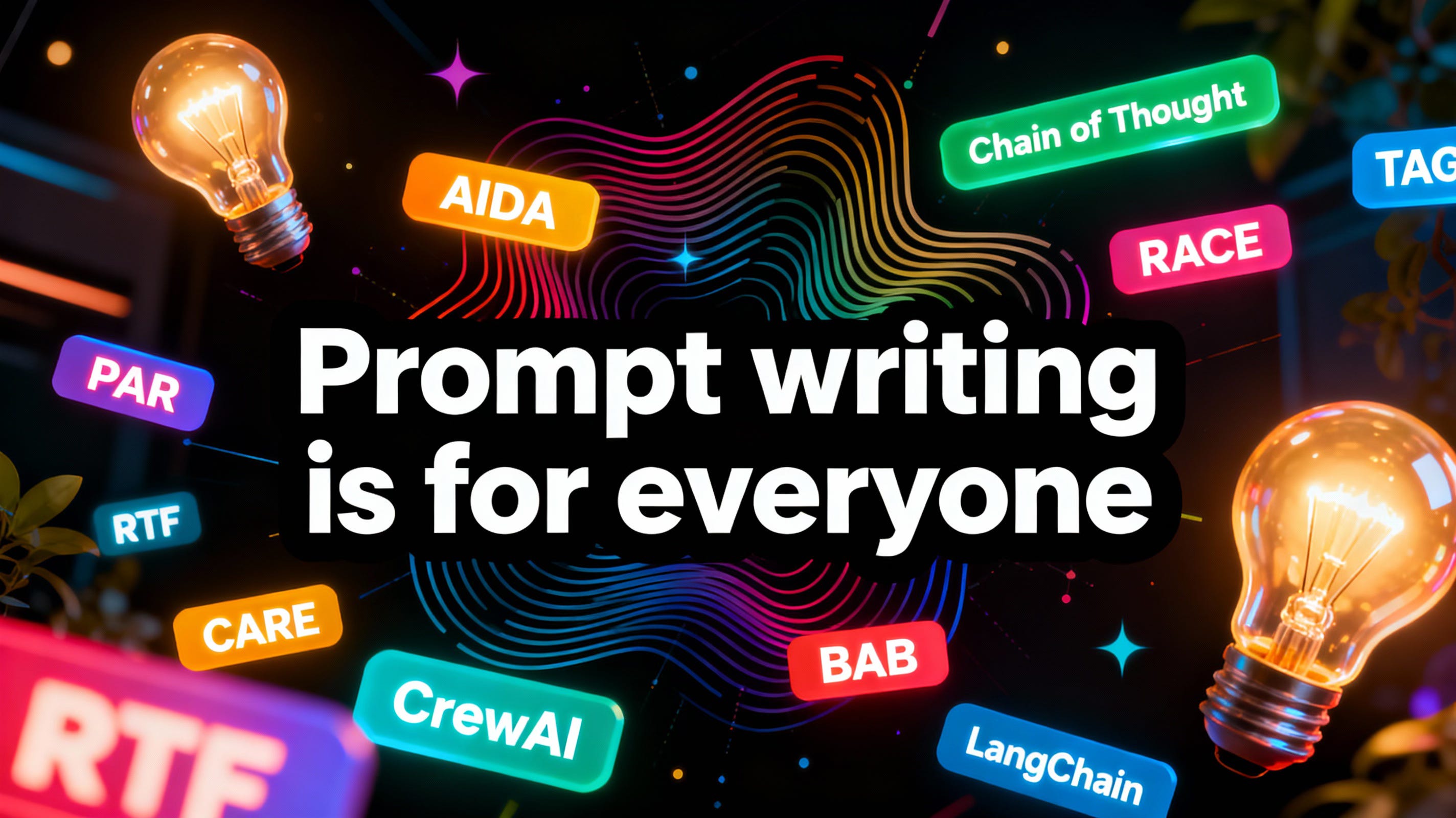
Content is still king. Yes, even in the age of AI, where crafting content can take just minutes, creating something truly valuable still takes hours and real efforts. Brainstorming ideas with a bot to create content that stands out from what the bot itself writes is a whole new challenge, and a big one. Plus, the way we approach content strategy and structure has changed dramatically with AI, and at the center of it all is the PROMPT.
Prompt writing (prompt engineering) is still new for most of us, and we’re all still getting the hang of it. In the AI era, your content is only as good as your prompt. That’s why it’s so important to ask your AI tools the right thing, in the right way, to get the right results.
So, if you spend a lot of time working with AI tools but still struggle to get exactly what you’re looking for, this guide is for you. I’ll guide you through writing prompts that AI truly understands and help you get the most out of these tools, without compromising your creative spark.
Prompt writing is for everyone using AI
If you use AI tools for anything, prompt writing is for you.
I’ve seen many professionals who believe that “prompt writing” is a niche or advanced skill, limited to writers, marketers, or developers, and not for them. This assumption leaves out everyone else who could benefit from AI to make their work better, faster, and smarter.
Even those who see prompt writing as central to their work often aren’t sure how to do it right. Most of us rely on just one approach: “PROMPT AND PRAY.” We start with a vague prompt, engage in a long conversation with AI, and hope to get the results we’re looking for. But usually, we end up with generic answers and growing frustration. This can make AI feel useless for our specific needs or make mastering it seem too difficult. A big part of the problem is that many of us treat AI like a random Google search, when what it really requires is intention and clarity.
A Microsoft report from May 2024 found that AI “power users” are 37% more likely to get training on prompt writing for their role-specific needs. So, no matter what role you are in, prompt writing can act as a bridge between your thoughts or intentions and the AI output.
AI thought leader Ethan Mollick puts it perfectly, “A well-written prompt can work like a compass for your AI - it guides the bot to deliver what truly matters to you.” With millions relying on AI to generate content every day, prompt writing is no longer just a good-to-have skill. It’s a competitive edge to ensure your voice, ideas, and goals get the right direction to break through the digital noise.
How to write prompts that get you exactly what you want
If you’ve come this far, you’re already on your way to getting more out of AI, no matter who you are and what you do. It all starts with how you communicate with your favorite AI tools. When writing prompts, using the right frameworks for your specific task can make all the difference.
Let’s explore the most effective prompt frameworks, with clear examples and practical guidance on how to use each one well.
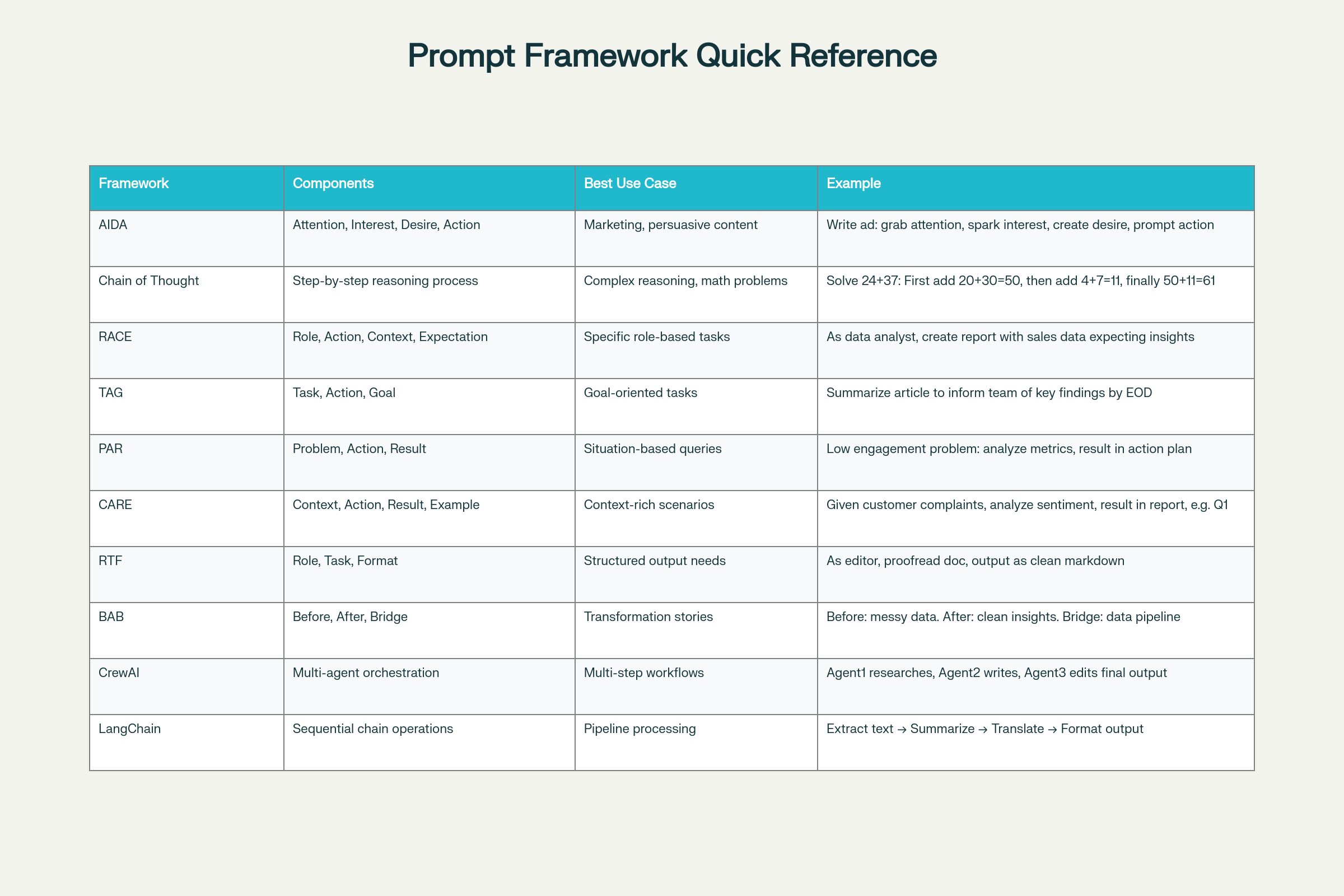
1. AIDA framework (Attention, Interest, Desire, Action)
A classic go-to format in marketing and copywriting and my personal favorite for crafting compelling marketing copies. AIDA stands for Attention, Interest, Desire, and Action: four stages that help you guide your audience toward the action you want them to take. First, you grab their attention, then spark their interest, build a genuine desire for what you offer, and finally, make it easy for your audience to act.
It’s one of the most widely used frameworks for persuasive content that moves people from initial engagement all the way to conversion.
Example:“Act as an expert copywriter and write a persuasive product description for [Product] using the AIDA framework. Start by grabbing the reader’s attention, build their interest with key features, create desire by highlighting unique benefits, and finish with a compelling call to action.”
Best for: AIDA is ideal for copywriters, marketers, sales teams, brand managers, content strategists, and business owners who need persuasive content such as ads, landing pages, emails, and campaigns where the main goal is to drive action. If you want your copy to deliver real results, AIDA is hard to beat.
2. Chain of Thought framework
Chain of Thought is gaining popularity among those who appreciate detailed reasoning. This approach gets the AI to break down complex concepts step by step, resulting in clear and thoughtful outputs. Instead of jumping straight to the conclusion, it guides both the AI and you through each stage of the thought process, making the results more transparent and much easier to follow.
Example:
“Take a close look at this Python script. First, list any bugs or errors you find and explain why they’re problems. Next, suggest specific fixes for each bug. Finally, rewrite the script with your improvements and add comments to explain the changes.”
Best for: Chain of Thought is perfect for anyone who enjoys solving problems, analyzing data, synthesizing research, or tackling tasks that require logical, step-by-step reasoning. It is especially valuable for data analysts, researchers, developers, engineers, consultants, project managers, educators, and students, as well as anyone who benefits from breaking down complex concepts into clear, actionable steps.
3. RACE framework (Role, Action, Context, Expectation)
The RACE framework is widely used in content creation and marketing, especially when you want the AI to deliver precise, role-driven results. RACE stands for Role, Action, Context, and Expectation. Start by defining the role you want the AI to play, lay out the specific action you need, provide some background context, and finish with what you expect as the outcome. The better you explain to the AI exactly what you’re looking for, the more relevant and tailored results you will get.
Example:
“Act as a social media manager and draft a LinkedIn post announcing our partnership with [Partner Company]. The post should be professional, highlight what both companies bring to the table, and encourage networking among industry peers.”
Best for: Detailed marketing campaigns, tutorials, step-by-step guides, or any scenario where clarity, tone, and meeting expectations are crucial. RACE is very useful for marketers, content creators, social media managers, product managers, project managers, technical writers, and educators. If you want your prompts to feel more like a creative brief and less like guesswork, RACE is the way to go.
4. TAG framework (Task, Action, Goal)
The TAG framework is my go-to when I need to get things done quickly and efficiently, especially for marketing content that doesn’t require a lot of creative spin or storytelling. TAG stands for Task, Action, and Goal. It’s all about keeping things simple and clear. You lay out exactly what you want the AI to do, the action it should take, and the specific result you’re looking for. No complicated briefs or layered instructions—just straight to the point, so you get what you need without any fuss.
TAG is absolute magic for those simple, fast marketing tasks where you don’t need a fancy tone or complex style, but you still care about getting the right results.
Example:
“Write a quick post reminding followers about our upcoming live event and include the date and time.”
Best for: Quick, repetitive marketing content like tweets, basic announcements, or reminders that don’t require a lot of variation in voice. TAG is especially useful for marketers, social media managers, email marketers, communications specialists, project managers, and anyone who needs clear, focused copy that just works.
5. PAR framework (Problem, Action, Result)
PAR is a no-nonsense approach to solving marketing or business problems. It stands for Problem, Action, and Result. You start by laying out the problem, clearly stating what needs attention. Next, you ask for a specific action or solution from the AI. Finally, you define the result you want to see, describing what success looks like for you. This straightforward method helps you get practical results without any extra hassle.
Example:
“Problem: Users are abandoning the app during the onboarding process.
Action: Analyze feedback and suggest improvements to the onboarding flow.
Result: Increase user retention by 20% within two months.”
Best for: Business strategy, marketing challenges, or any decision-making prompt where you want clear, actionable solutions. PAR works wonders for business leaders, marketers, consultants, managers, entrepreneurs, analysts, and anyone who needs practical ideas that actually move the needle. If you want to keep things focused and results-oriented, try PAR.
6. CARE framework (Context, Action, Result, Example)
CARE is quickly becoming a favorite for anyone who wants extra clarity and direction in their prompts. What sets CARE apart is that you’re not just telling the AI what you want—you’re also showing it, with a real example. CARE stands for Context, Action, Result, and Example. You start by setting the scene with a bit of background (context), then explain the exact action you want the AI to take. Next, you lay out what success looks like (the result), and finally, you provide an example so the AI knows the style, tone, or format you’re aiming for.
Example:
“Context: Audience is eco-conscious millennials.
Action: Write Instagram captions promoting our sustainable brand.
Result: Captions should be trendy and inspiring.
Example: “Eco-friendly never looked so good! #GreenAndStylish”
Best for: Social media managers, marketers, content creators, brand strategists, communications specialists, copywriters, and community managers who want messaging that’s not just on-brand, but also consistent, audience-aligned, and up to a certain standard every single time. If you want to raise the quality bar and take the guesswork out of creative prompts, CARE is the framework you’ll want to keep handy.
7. RTF framework (Role, Task, Finish)
RTF is quite popular among people who want quick, focused results without any ambiguity. It stands for Role, Task, Finish. With this framework, you tell the AI what role to assume, lay out the specific task you need done, and clearly state how you want it to wrap up or what the endpoint should be. It’s a straightforward approach that helps you get targeted, role-specific outputs with a well-defined finish, all without over-explaining.
Example:
“Role: Product copywriter
Task: Write a 150-word product description for [Product]
Finish: End with a call to action encouraging purchase.”
Best for: Tight, focused content pieces like emails, product descriptions, or social posts where you want the AI to stay on-topic and deliver exactly what you asked for, right up to the finish line. RTF is a great fit for copywriters, content marketers, email marketers, social media managers, product managers, sales professionals, project managers, and anyone who values clarity and efficient, goal-oriented writing.
8. BAB framework (Before, After, Bridge)
The BAB framework is all about storytelling with impact. It stands for Before, After, and Bridge, and it’s designed to help you show transformation in a way that feels real and relatable. You start by painting a picture of what things looked like before—maybe the struggles, the frustrations, or the missed opportunities. Then you reveal the “after,” highlighting how things have improved or what success looks like. The bridge connects the two, showing exactly how your product, service, or idea helped make that change possible.
Example:
“Before using [App Name], managing daily tasks felt overwhelming and unorganized. After switching to [App Name], I finally have a clear overview of my priorities and get more done in less time. Make the same change today and see how effortless productivity can be!”
Best for: Narrative ads, email campaigns, and brand storytelling that needs an emotional connection. BAB is particularly valuable for content marketers, copywriters, brand managers, social media managers, sales professionals, communications specialists, PR professionals, and anyone who wants to demonstrate real value and motivate their audience with real stories of change.
9. CrewAI framework
CrewAI is for teamwork. This framework comes into play when you need multiple AI agents, each with their own specialized role, working together to get a bigger task done. It’s quite popular among teams building multi-agent AI workflows, where coordination and collaboration between different “AI experts” can really take your results to the next level. With CrewAI, you can assign specific tasks to different agents, making sure each part of your project is handled by the right “expert,” just like you would with a real team.
Example:
“Agent 1: Research trending topics in digital marketing.
Agent 2: Outline a blog post based on the research findings.
Agent 3: Write the introduction and conclusion for the blog post.
Agent 4: Edit the full draft for clarity, grammar, and consistency.”
Best for: Developers and teams who are prototyping complex AI collaborations or building workflows that require multiple steps, perspectives, or areas of expertise. CrewAI is especially helpful for AI engineers, software developers, data scientists, product managers, project managers, operations specialists, workflow designers, and anyone working on projects where AI needs to act as a coordinated team. This framework helps you orchestrate those roles and keep everything running smoothly.
10. LangChain framework
LangChain is for those who are ready to take things to the next level with AI. It’s one of the most advanced frameworks out there, used mainly by developers and AI engineers who want to build truly dynamic, context-aware applications. LangChain lets you chain together multiple AI prompts, manage memory across interactions, and automate complex decision-making processes. This means you can create AI tools that can remember past conversations, adapt to user needs, and deliver a much more personalized experience.
Example Use:
“Create a tool with LangChain that reads a set of research papers, extracts key findings from each, stores the findings, and then answers follow-up questions by referencing the stored information.”
Best for: AI engineers and developers building dynamic, multi-turn AI applications, especially when context preservation, automation, and a seamless user experience are key. LangChain is also valuable for machine learning engineers, data scientists, product managers, workflow architects, software architects, and anyone who wants their AI to act less like a simple assistant and more like a smart, evolving partner.
Wait… did I tell you about Persona Prompts? Oops, how did I miss that?
Persona prompts are one of those game changers in AI content creation that deserve their own spotlight. While prompt frameworks help structure your requests, persona prompts add the magic touch by giving your AI a unique voice and personality to work with.
When you clearly define a persona, whether it is a marketing author, experienced coder, friendly fitness coach, seasoned industry expert, or witty social media manager, you ensure your AI-generated content truly speaks in your brand’s voice. This makes your writing feel authentic, relatable, and consistent across platforms.
Mixing persona prompts with frameworks like RACE or CARE can do wonders, making your content sound like it is coming from someone who really knows your audience.
The real magic of prompt writing happens when you blend the right framework with the right persona, designed for your audience.
Mix & Match frameworks for maximum impact (the secret sauce)
One of the best practices I follow is to adjust and refine my prompts as I go. Sure, it helps to start with a solid framework and some basic ground rules, but don’t be afraid to experiment. Sometimes, simply adding a word, a phrase, or even combining two frameworks can get you results that are far better than your first attempt. The real magic happens when you mix and match frameworks to fit your specific task and professional needs.
Let’s look at how you can blend frameworks for even more impact and which combinations work best for different roles:
Certainly! Here’s your content reformatted for clarity and easy reading:
For Marketers and Copywriters:
Try combining AIDA with CARE. Start with the persuasive flow of AIDA, but include a specific example in your prompt (from CARE) to set the tone or style you want.Example: Act as an expert copywriter and write a social media ad using the AIDA framework to promote [Product] to [Target Audience]. The goal is to encourage them to sign up for a free trial. Example: “Get started for free—see results in days!”
For Technical Professionals and Analysts:
Blend Chain of Thought with PAR to get both detailed reasoning and actionable outcomes.Example: Analyze this dataset. Step 1: Identify any anomalies. Step 2: Suggest three possible causes. Step 3: Recommend actions to resolve them. Result: Reduce reporting errors by 30%.
For Social Media Managers:
Mix RACE and TAG for role-driven, efficient campaigns.Example: Act as a social media manager. Task: Draft a LinkedIn post announcing our partnership with [Partner Company]. The goal is to highlight benefits for both brands and encourage followers to engage.
For Product Managers and Sales Professionals:
Use RTF with AIDA to craft focused, persuasive product messages.Example: You are a product manager. Task: Write a 100-word product description for [Product] using the AIDA framework. Finish with a call to action inviting prospects to book a demo.
For Brand Managers and Content Strategists:
Pair BAB with CARE for storytelling that’s both emotional and consistent in style.Example: Write a case study using the BAB framework for our new service. Context: Audience is small business owners. Result: The story should feel motivating and real. Example: “Before, scheduling was chaos. After, efficiency soared. We made it happen together.”
For Developers and AI Teams:
Combine CrewAI and LangChain when building complex, multi-agent AI workflows.Example: Design an AI support platform using CrewAI. One agent collects user data, another troubleshoots, and a third suggests upsells. Use LangChain to make sure the system remembers user preferences across sessions.
Start writing right prompts today!
No matter your profession, don’t feel locked into a single framework. The real strength in prompt writing comes from knowing when to stick to the basics and when to experiment with blends that match your goals. Try different combinations, refine your approach, and see how much more you can achieve with AI.
Have you found a framework or mix that works especially well for you? Share your results, creative tweaks, or any breakthrough prompt tips in the comments. I’d love to hear your stories and questions so we can all learn together.
If you’d like more guides like this or have a specific topic in mind for AI content strategy, let me know in the comments or reach out directly. And if you haven’t already, hit that subscribe button before you go.
Let’s make content marketing even smarter with AI.